Vibrant Communities Calgary - Enough For All

Article

Understanding disability poverty in Alberta

Exploring the realities of disability poverty, the systems that contribute to it, and opportunities for change

2 July 2026

For thousands of Albertans, disability and poverty are deeply connected experiences. While disability can affect anyone at any stage of life, people living with disabilities are significantly more likely to experience financial hardship. While not everybody with a disability experiences poverty, the prevalence of poverty is higher among people with disabilities than people without disabilities. 
Higher costs associated with disability, combined with lower incomes and systems that do not fully account for either, create additional barriers that contribute to the lived realities of poverty for many people.  
As Alberta's disability income support system undergoes significant changes this month, the conversation about disability poverty has become more important than ever. Behind policy debates are real people trying to afford housing, food, transportation, medication, and other essentials while navigating barriers that many Albertans never encounter. This article will explore what disability and poverty look like in Calgary and Alberta, the structural and systemic contributors to disability poverty, and recommendations for change. 

Key Takeaways

  • Nearly one in four (24%) of Calgarians have at least one disability, with 40% of those having severe or very severe disabilities. Provincially, 27.5% of Albertans had at least one disability, similar to the national rate of 27%. 
  • Many Albertans with disabilities rely on disability related financial assistance. As of March 2026, there were 80,257 Assured Income for the Severely Handicapped and 19,555 Income Support – Barriers to Full Employment recipients. 
  • Systemic barriers, including inaccessible housing, employment and inadequate income supports are some of the primary drivers of disability poverty. 
  • In Alberta, disability income support programs do not provide enough income to meet basic needs or reduce poverty. After paying for housing, many disability benefit recipients have little or no income left for food or other essential expenses. 
  • Alberta's lack of comprehensive accessibility legislation leaves people with disabilities facing inconsistent accessibility standards and protections.

Disability and Poverty in Alberta

The 2022 Canadian survey on Disability found that 27.5% of Albertans had at least one disability (aligned with the national prevalence of 27%).[1] The survey also found that 24% of Calgarians had at least one disability, with 40% of those with disabilities in Calgary having severe or very severe disabilities.[2] The most common types of disabilities in Calgary are related to pain, mental health, flexibility, and mobility.[3] 
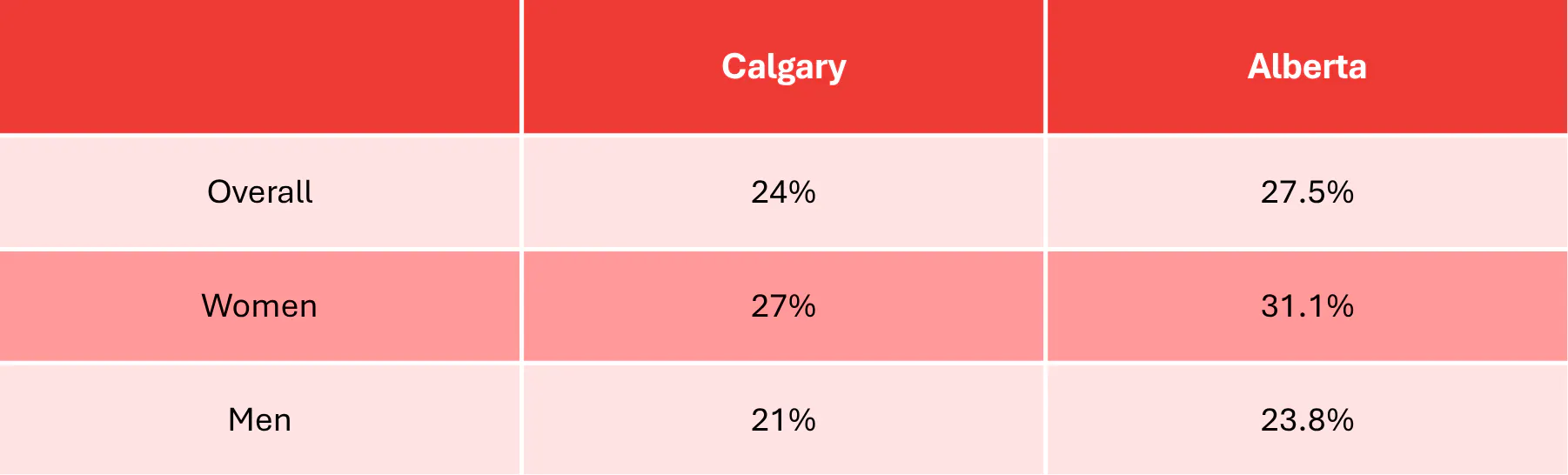
 In Calgary and Alberta, women are more likely than men to have at least one disability, with 27% of women in Calgary having at least one disability, compared to 21% of men (31.1% women and 23.8% men Alberta-wide). Disabilities are also more prevalent among older Calgarians, with 42% of Calgarians over the age of 65 having at least one disability compared to 21% of 15-64 year-olds.[4] 
Table 1. Disability rates among Calgarians, Albertans and Canadians by gender.

The median income for persons with disabilities 15 and older in Canada was $38,100 in 2024[5] and the median after-tax income for persons with disabilities in Calgary between the ages of 15-64 was $35,850 in 2021.[4] The median after-tax income for persons not in an economic family (single individuals) was $46,900 for Calgary overall in 2024.[6]
While Alberta-level data is unavailable[7], we know that in Canada overall, the Market Basket Measure (MBM) poverty rate for persons with disabilities is 12.6% compared to 8.4% for persons without disabilities.7 Research also suggests that the MBM should be approximately 30% higher for people with disabilities to account for true costs of living with a disability indicating that the true poverty rate for persons with disabilities is likely higher.[8]
In Alberta, Assured Income for the Severely Handicapped (AISH) and the new Alberta Disability Assistance Program (ADAP), as well as Income Support – Barriers to Full Employment, are the primary financial assistance programs for people with disabilities.  
As of March 2026, there were 80,257 Assured Income for the Severely Handicapped (AISH) recipients across Alberta, with 23,948 (29.8%) recipients living in Calgary.[9] A further 19,555 Albertans were receiving Income Support – Barriers to Full Employment (BFE).[10] Prior analyses from VCC suggests that many BFE recipients are long-term recipients, indicating they may be waiting for AISH assessments or unable to prove the permanency of their disability.[11] It has been estimated that approximately 50,000 AISH recipients will transition to ADAP as of July 2, 2026.[12]

Systemic Factors that Drive Disability Poverty

Disability poverty is often framed as an individual challenge, but systemic factors and inequalities are the predominant drivers of higher poverty rates among people with disabilities. Factors like a lack of accessible and affordable housing, inaccessible workplaces and barriers to inclusive employment, and income assistance programs that do not allow recipients to meet their basic needs further shape disability poverty. 
Housing 
Calgary’s housing affordability crisis affects everyone, but people with disabilities face the additional challenge of finding housing that is both affordable and accessible. Accessible housing refers to a home that is either designed or retrofitted to remove barriers and enable safe, independent living.[13]
Accessible, non-market units (affordable units that are owned and operated by government or non-profit housing providers), remain in short supply across Calgary, with organizations like Accessible Housing Calgary highlighting that in Calgary and Edmonton, only an estimated 2-3% of affordable housing units are fully accessible.[14] Additionally, AISH recipients have historically benefited from some exemptions in their total income used to calculate subsidized rent in community housing. In 2025, the Government of Alberta changed the regulation which removed exemptions on portions of AISH income, resulting in an approximate $220 per month rent increase for recipients living in community housing.[15] The National Housing Council has recently undertaken a rights-based review on the lack of accessible housing in Canada overall, highlighting the national scale of this problem. 
In a recent Calgary study examining women’s housing and homelessness, 64% of survey respondents (women in Calgary who had, or were currently, experienced housing precarity or homelessness) reported also living with at least one disability.[16] According to the Canadian Human Rights Commission, people with disabilities are four times more likely to experience homelessness than people without disabilities.[17]
Barriers to Employment 
While many Albertans with disabilities want to work and contribute their skills, barriers such as inaccessible workplaces, transportation limitations, and employer misconceptions continue to reduce opportunities.  A recent University of Calgary analysis of the new ADAP program highlights key structural issues with Alberta’s employment landscape which serve to disadvantage people with disabilities.  For instance, Alberta is currently the only province in Canada without comprehensive accessibility legislation, which means that accessibility standards are likely not consistent across sectors and employers, and leaves employees vulnerable to discrimination based on disability. Results of the latest Canadian Survey on Disabilities show that among Canadians with disabilities not in the labour force, health conditions were commonly cited as limiting factors, as well as discrimination, inadequate training, and repeated unsuccessful job attempts.[18]
The analysis suggests that in fact, most workplace accommodations that were needed to increase workforce participation for employees with disabilities were relatively inexpensive and largely depended on employer willingness rather than individual capacity. The analysis also highlights gendered differences in workforce participation, as more women are living with disabilities in Alberta than men, and disproportionately report additional gender-based discrimination in the workforce and additional caregiving responsibilities that further limit workforce participation.[17]
In a survey of prospective ADAP recipients, non-permanent forms of employment and self-employment were cited as common types of employment among respondents.[19] Calgary’s Social Policy Collaborative recently highlighted the low wages and lack of worker protections in Alberta’s gig economy, consistent with the type of precarious self-employment described in the study.[20]
As the Province increases expectations for recipients of financial assistance to participate in the labour force, as is the case with the new ADAP program, it is important that these structural barriers to employment be addressed alongside the enhanced employment supports offered to individual recipients. Otherwise, ADAP recipients will likely face the same barriers to employment with a reduced monthly income, leading to deeper poverty. 
Table 2 shows the annual income gaps between AISH, ADAP, and IS-BFE core benefit levels and the MBM poverty rate for Calgary for a single individual living in a private dwelling. What is clear is that the programs designed to support Albertans who are unable or limited in their capacity to work due to either a permanent or temporary disability, are insufficient in supporting recipients to meet their basic needs and reduce the prevalence of poverty among persons with disabilities. 
 
Table 2. Core benefit rates of disability income support programs in Alberta, compared with the Market Basket Measure poverty rate (for a single individual living in a private dwelling). 
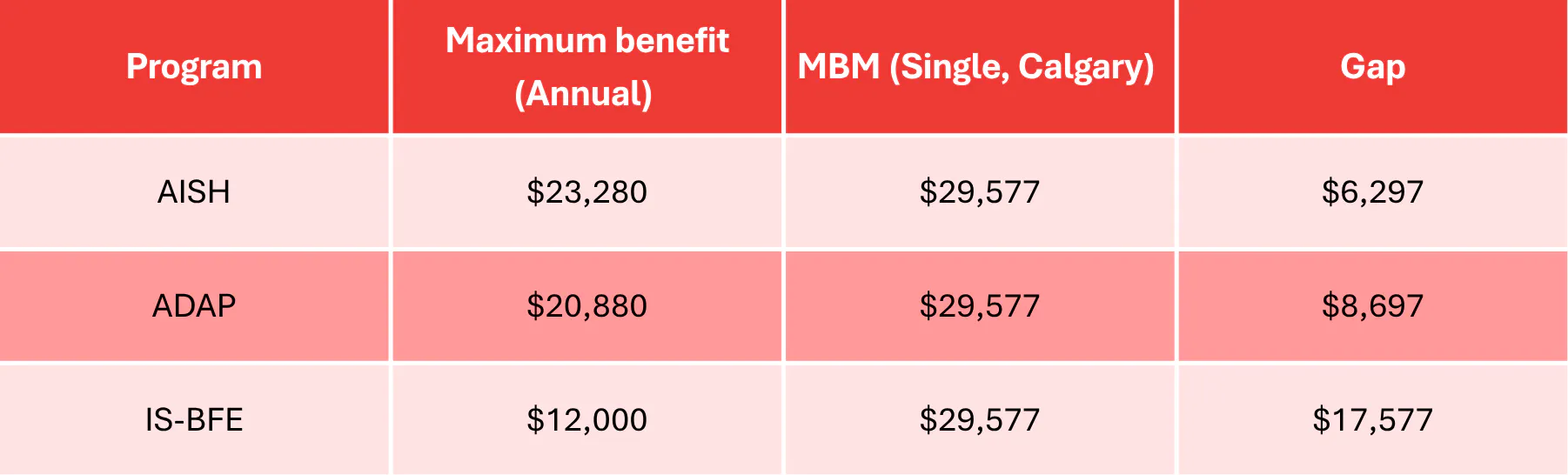
Abbreviations: ADAP – Alberta Disability Assistance Program; AISH – Assured Income for the Severely Handicapped; IS-BFE – Income Support Barriers to Full Employment; MBM – Market Basket Measure.

A recent collaborative brief from several disability advocacy and social serving organizations compared AISH core benefit levels with living wage expense categories for Calgary for 2024.[21] The analysis shows that with a monthly AISH benefit level of $1,901, 94% would be sufficient to cover average rent costs, with only 6% (or $108) left over for food expenses, and nothing left over for other basic living expenses like clothing or accessible transportation. The new ADAP core benefit would not be sufficient to afford an average rent of $1,793 in the absence of rental assistance or subsidized housing. In addition to accessible housing and food, Disability Without Poverty indicates that the true cost of a disability should also include costs associated with disability-specific equipment, over-the-counter and prescription medication, paramedical treatments (like physiotherapy), and costs associated with care providers.[22]
In addition to the provincial disability income support programs described above (AISH, ADAP and Income Support – BFE), Albertans with disabilities may also be eligible for federal supports.  The Disability Tax Credit (DTC), Canada Disability Benefit (CDB), and Canada Pension Plan Disability (CPP-D) are some additional government programs available for eligible Canadians. Notably, the Canada Disability Benefit offers a maximum benefit of $200/month. However, Alberta is the only province that has not treated this benefit as exempt income—meaning CDB recipients see this income clawed back dollar-for-dollar from their AISH or Income Support monthly payment. This will also apply to ADAP recipients after July 2, 2026. 
As has been explored earlier in this analysis, no single income support program for people with disabilities in Alberta is sufficient to lift recipients out of poverty. 
These challenges are not caused by disability itself. They are the result of systems that are often designed without disability inclusion in mind or that do not adequately address the needs of those living with disability. Intersecting and compounding forms of discrimination (like ableism, sexism, and racism) against people with disabilities also exacerbate experiences and depth of poverty for multiply marginalized individuals. 

What Would Reduce Disability Poverty?

Reducing disability poverty requires a multi-factor response that effectively addresses its systemic and structural drivers.  
 
Key areas for action 
Ensure AISH and ADAP benefit amounts are sufficient to support people in achieving a basic standard of living.  
  • Previous analysis suggests that even when considering other available benefits, core benefit amounts for Alberta’s disability income support programs fail to bring people to a level of income that meets a standard poverty measure. 
Ensure disability benefits keep pace with the cost of living by removing the 2% cap on the Alberta Escalator. 
  • Currently, benefit amounts for income support programs in Alberta are adjusted via the Alberta Escalator. The Alberta Escalator requires that benefit payments be set annually at a prescribed rate. If no prescribed rate is made, then benefits are adjusted in accordance with inflation, capped at 2%. 
Expand the supply of affordable and accessible housing.  
  • Given the large portion that housing accounts for in the budgets of people with low income, increasing the stock of affordable and accessible homes would potentially ease cost pressures faced by this demographic. 
  • Increasing the supply of non-market accessible housing could also help alleviate cost pressures faced by people with disabilities. 
Explore ways to further legislate, mandate, or otherwise encourage inclusive, accessible employment spaces within the province. 
  • The physical space of many workplaces hinders employment prospects for people with disabilities. Creating more inclusive workplaces and employment opportunities would help people with disabilities succeed in the labour market. 
Reconsider the requirement that ADAP recipients seek employment to remain eligible for the program.  
  • Disabilities in themselves can prevent individuals from being able to seek work. In some cases, it may be difficult for administrators to fully appreciate the extent to which someone’s health is preventing them from finding a job.  
  • For instance, when considering relapsing and remitting conditions, acute periods of illness may not be obviously visible to others. As a result, many individuals the program is meant to help could be removed.  
Explore adding a wage subsidy program in which the ADAP program reimburses employers that hire ADAP recipients. 
  • At present, we cannot find evidence that such a program exists within ADAP.23 However, some existing research suggests that such programs may help people with disabilities find employment.[24]
  • However, the exact details of employer incentive programs are important to ensure they incentivize additional hiring and long-term attachment to the labour force, as not all program designs offering wage subsidies to hire those with disabilities have been effective.[25]
     
When designing policies, incorporate people who have lived experience of disability and poverty. 
  • The perspectives of those with lived experience will be essential in designing policies that are successful in enabling employment success for people with disabilities. 

Conclusion

When designing solutions, it is important that decision-makers recognize that disability poverty is not inevitable. It is a consequence of public policy, community investment, and collective choices. A strong and inclusive Alberta is one where people with disabilities can participate fully in community life, pursue meaningful opportunities, and live with dignity. 
Reducing disability poverty is not simply about increasing income, though income inadequacy is a concern. Other key relevant levers include removing barriers, expanding opportunities, and ensuring that people with disabilities have the resources they need to thrive. As Alberta's disability support system continues to evolve, the question is not whether we can afford to reduce disability poverty. The question is whether we can afford not to.  
For instance, in March 2026, just 15.4% of AISH recipients were employed.[26] As previous research from the Calgary Social Policy Collaborative suggested that employed Income Support recipients cost taxpayers less in benefits than unemployed recipients, increasing employment rates could generate substantial savings to the government and help ADAP recipients thrive in the places where they live.[27] However, punitive approaches and negative incentives are unlikely to yield positive results. A program that ensures stability for recipients is essential for enabling labour market success. 
When people with disabilities have access to adequate income, stable housing, meaningful work, and supportive communities, the benefits extend far beyond the individuals themselves. Families are stronger, communities are more inclusive, and Alberta is better positioned to succeed. 

Sources

[1] Government of Alberta, Canadian Survey of Disability, 2022 (Edmonton: Government of Alberta, 2024), https://open.alberta.ca/dataset/f7335a01-6feb-43d8-9621-93b936562a81/resource/31f2b555-a13f-4fe8-965d-aa0f3ae253ad/download/tbf-canadian-survey-of-disability-2022.pdf
[2] The City of Calgary, The City of Calgary Population Profiles – Disability (2022) (Calgary: The City of Calgary, 2024), page 2, https://www.calgary.ca/content/dam/www/csps/cns/documents/Disability-Population-Profile-2022.pdf
[3] Pain-related disabilities limit somebody’s daily activities because of pain; mental health-related disabilities limit somebody’s daily activities because of an emotional, psychological or mental health condition; flexibility disabilities limit somebody’s daily activities because of difficulty bending down or reaching, and mobility disabilities limit somebody’s ability to move around in daily activities (like walking or using stairs).
[4] The City of Calgary, The City of Calgary Population Profiles – Disability (2022) (Calgary: The City of Calgary, 2024), page #, https://www.calgary.ca/content/dam/www/csps/cns/documents/Disability-Population-Profile-2022.pdf
[5] Statistics Canada, “Table 11-10-0088-01: Population with and without disabilities by age group and gender, Canada, provinces and territories, census metropolitan areas and census agglomerations, 2022,” accessed June 30, 2026, https://www150.statcan.gc.ca/t1/tbl1/en/tv.action?pid=1110008801.
[6] Statistics Canada, Table 11-10-0190-01: Market income, government transfers, total income, income tax and after-tax income by economic family type, accessed June 30, 2026, https://www150.statcan.gc.ca/t1/tbl1/en/tv.action?pid=1110019001.
[7] Statistics Canada, Table 11-10-0090-01: Poverty and low-income statistics by disability status, accessed June 30, 2026, https://www150.statcan.gc.ca/t1/tbl1/en/tv.action?pid=1110009001.
[8] Craig W. M. Scott, Patrick S. Berrigan, Ronald D. Kneebone, and Jennifer D. Zwicker, “Disability Considerations for Measuring Poverty in Canada Using the Market Basket Measure,” Social Indicators Research 163, no. 1 (2022): 389–407, https://doi.org/10.1007/s11205-022-02900-1
[9] Government of Alberta, Assured Income for the Severely Handicapped (AISH) Caseload (Edmonton: Government of Alberta, accessed June 30, 2026), https://open.alberta.ca/opendata/assured-income-for-the-severely-handicapped-aish-caseload-alberta
[10] Government of Alberta, Income Support Caseload (Edmonton: Government of Alberta, accessed June 30, 2026), https://open.alberta.ca/opendata/income-support-caseload-alberta.
[11] Vibrant Communities Calgary, Liveable Incomes: Improving the Effectiveness of Alberta's AISH Program (Calgary: Vibrant Communities Calgary, August 3, 2023), https://enoughforall.cdn.prismic.io/enoughforall/09f7cabc-8d0e-4367-af68-42c5664cda08_Liveable+Incomes-Improving+the+Effectiveness+of+AISH+%282%29.pdf
[12]Jardine, M., Fyie, K., and Zwicker, J. (2026). Reforming Disability Income Support in Alberta for Employment and Equity. The School of Public Policy, University of Calgary. 2026-06-25 Reforming Disability Income Support in Alberta for Employment and Equity | School of Public Policy | University of Calgary
[13] National Housing Council, “Frequently Asked Questions,” accessed June 30, 2026, https://nhc-cnl.ca/about-us/faqs
[14] Accessible Housing Society, “Alberta’s Overlooked Crisis: The Urgent Need for Accessible Affordable Housing,” Accessible Housing Calgary, accessed June 30, 2026, https://accessiblehousing.ca/albertas-overlooked-crisis-the-urgent-need-for-accessible-affordable-housing
[15] Inclusion Alberta, “The Difference Between Almost Living and Barely Existing: On the Heels of Previous Cuts, Alberta Government Raises Rent by 63% for AISH Tenants in Community Housing,” Inclusion Alberta, July 16, 2025, https://inclusionalberta.org/connections/media-release-the-difference-between-almost-living-and-barely-existing-on-the-heels-of-previous-cuts-alberta-government-raises-rent-by-63-for-aish-tenants-in-community-housing/
[16] Baig, K., Mousavi Samimi, P., Sherwani, A., Eiboff, F., and Seccia, S. (2026). Unaddressed: Final Report The State and Scale of Housing Insecurity and Homelessness Experienced by Women & Gender-Diverse People in Calgary. https://static1.squarespace.com/static/68a3ae7d4e30836b0207cf61/t/69ceec7d358f916e15be62a4/1775168637554/Unaddressed_FinalReport_02042026.pdf
[17] Canadian Human Rights Commission, “Homelessness – Monitoring the Right to Housing for People with Disabilities,” Monitoring the Right to Housing for People with Disabilities, last modified June 19, 2024, https://www.chrc-ccdp.gc.ca/resources/publications/monitoring-the-right-housing-people-disabilities/homelessness-monitoring-the-right-to-housing-for-people-with-disabilities.
[18] Jardine, M., Fyie, K., and Zwicker, J. (2026). Reforming Disability Income Support in Alberta for Employment and Equity. The School of Public Policy, University of Calgary. 2026-06-25 Reforming Disability Income Support in Alberta for Employment and Equity | School of Public Policy | University of Calgary
[19] Petit, G. (2026). An evaluation of the economic well-being of persons receiving income supports and persons with disabilities in Alberta – Preliminary Report. Retrieved from: Pre-ADAP Baseline: Economic Well-Being of Albertans with Disabilities and on Income Assistance | INCLUSIECON
[20] Calgary Social Policy Collaborative, The State of Gig Work in Alberta: Trends, Challenges, and Solutions (2025), https://enoughforall.cdn.prismic.io/enoughforall/aTdsrHNYClf9n8bg_SPC_TheStateofGigWorkinAlbertaReport_December2025.pdf
[21] Canada Disability Benefit Lived Experience Brief, CDB Lived Experience Brief (2025), https://static1.squarespace.com/static/619fef1c85bda14d5d1ebda2/t/687e95e8f615bb045c3dcfbf/1753126379667/CDB+Lived+Experience+Brief_Final_July25.pdf
[22] Disability Without Poverty, Alberta Report (November 2024), https://www.disabilitywithoutpoverty.ca/sites/default/files/2024-11/Alberta%20report%20website.pdf
[23] Government of Alberta. (n.d.). Alberta Disability Assistance Program. https://www.alberta.ca/alberta-disability-assistance-program#jumplinks-0.
[24] Derbyshire, D. W., Jeanes, E., Morasae, E. K., Reh, S., & Rogers, M. (2024). Employer-focused interventions targeting disability employment: A systematic review. Social Science & Medicine347, 116742.
[25] Derbyshire, D. W., Jeanes, E., Morasae, E. K., Reh, S., & Rogers, M. (2024). Employer-focused interventions targeting disability employment: A systematic review. Social Science & Medicine347, 116742.
[26] Government of Alberta. (June 16, 2026). Assured Income for the Severely Handicapped (AISH) Caseload. https://open.alberta.ca/opendata/assured-income-for-the-severely-handicapped-aish-caseload-alberta.
[27] Calgary Social Policy Collaborative. (November 18, 2024). Income Support Policy Brief. https://www.socialpolicycollaborative.ca/resources/social-policy-collaborative-income-support-policy-brief.

A woman is sitting in a wheelchair and holding up a piece of paper.

Understanding Disability Poverty in Alberta

Read the full policy brief, where VCC explores the realities of disability poverty, the systems that contribute to it, and opportunities for change.

Focus Areas

Attribution

  • Patrick Berrigan

Related Articles

Newsletter